
Ingredients
Main Ingredients (3-4 servings)
Seasonings
Steps
- In a bowl, combine miso paste 50g, sugar 1.5 tbsp, cooking sake (rice wine) 1.5 tbsp, and mirin (sweet rice wine) 1 tbsp. Mix well until the sugar dissolves. (Key Tip!) The alcohol in the sake and mirin evaporates due to the miso's properties, so you can use them without cooking them down. If you're concerned, microwave the mixture to evaporate the alcohol.
- Finely chop 1/2 green onion.
- Roughly chop 3 shiso leaves.
- Add the chopped green onion and roughly chopped shiso leaves to a bowl.
- To the bowl from step 4, add kombucha powder 1 tsp, sugar 1 tsp, salt 1.5 tsp, grated ginger 1/2 tsp, sesame oil 1 tsp, and water 120cc. Mix until the kombucha powder, sugar, and salt dissolve.
- In a pot, combine dashi stock 120cc, soy sauce 2 tbsp, mirin (sweet rice wine) 2 tbsp, and sugar 1 tbsp. Bring to a boil.
- Turn off the heat and let the prepared soy sauce mixture cool.
- Prepare a pot with plenty of boiling water.
- Gently place 12 eggs, fresh from the refrigerator, into a colander and lower them into the boiling water. (Key Tip!) To prevent the eggs from cracking on the bottom of the pot, use a colander and lower them gently into the water.
- Boil the eggs for 7.5 minutes. For the first 1 minute, gently roll the eggs to center the yolks. (Key Tip!) Rolling the eggs for the first minute centers the yolks, resulting in beautifully presented ajitama.
- Immediately transfer the boiled eggs to ice water to cool them rapidly. (Key Tip!) Rapid cooling makes the shells easier to peel and prevents overcooking from residual heat.
- Lightly crack the shells of the eggs and peel them under water. (Key Tip!) Peeling the shells under water allows water to get between the shell and the egg white, resulting in a smooth, clean peel.
- Place the peeled eggs into storage bags, 4 at a time.
- Pour the cooled soy sauce mixture into the bags from step 13, removing air and ensuring the eggs are fully submerged.
- In separate bags, add the prepared miso marinade. Gently handle the eggs to coat them evenly, and remove air. (Key Tip!) If you prefer spicy ajitama, add ichimi togarashi, doubanjiang, or gochujang.
- In another set of bags, add the prepared green onion salt marinade. Gently handle the eggs to coat them evenly, and remove air. (Key Tip!) Adding garlic instead of, or in addition to, ginger will provide a more punchy flavor. Adding celery can also enhance the flavor.
- Refrigerate the three types of ajitama and let them marinate for at least 1 hour (ideally half a day or longer).
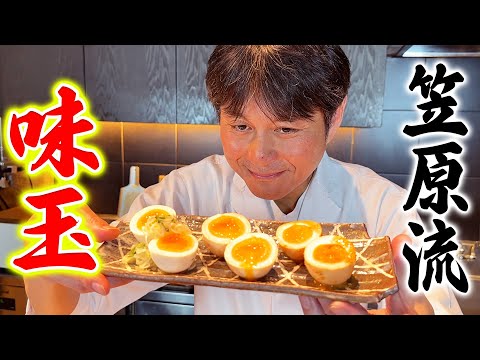
- Remove the marinated ajitama from the refrigerator and cut them in half using thread. (Key Tip!) Using thread instead of a knife is a great way to cut the eggs cleanly.
- Drizzle a little of the remaining green onion salt marinade over the cut green onion salt ajitama.
🌾 Recommended Rice for This Dish
※HowToCook.JPが料理の特徴に合わせて選定しています。動画内でシェフが推薦したものではありません。
* Contains affiliate links
*This article contains Amazon affiliate links. We may earn a commission on qualifying purchases.
【賛否両論】笠原将弘の料理のほそ道さんの他のレシピ


Amazon 📦 Items for This Recipe (Editorial Picks) 3点
※Not endorsed by the chef. Selected by HowToCook.JP editorial team.
PR: Contains Amazon affiliate links


🍷 編集部おすすめペアリング
※HowToCook.JP編集部による提案です。動画内でシェフが推薦したものではありません。
シャトー・メルシャンの甲州を代表する銘柄きいろ香。繊細な和柑橘と上品なミネラル感。和食全般・刺身・天ぷらにぴったり
8–10℃ Amazonで探す →ニュージーランド マールボロの代名詞クラウディー・ベイ。青草・柑橘・ハーブの爽やかな香り。サラダ・山羊チーズ・シーフードに最適
8–11℃ Amazonで探す →吟醸香と米の旨みが調和した飲みやすい一本。焼き魚・煮魚・和風パスタなど和食全般に合わせやすい
10–15℃(冷酒・花冷え) Amazonで探す →米と米麹のみで醸したコク豊かな純米酒。燗にすることで旨みがさらに開花し、煮物・焼き鳥・濃い味の惣菜と絶妙にマッチ
15–55℃(常温〜熱燗) Amazonで探す →火入れをしない生酒ならではの溌剌とした風味とフレッシュな香り。刺身・カルパッチョ・夏野菜の浅漬けなど、素材の鮮度を活かした料理に最適
5–10℃(雪冷え〜花冷え) Amazonで探す →国産ホップを使ったフレッシュで繊細な香り。アルコール度数は低めで飲みやすい。和食・刺身・冷奴と驚くほどよく合う
6–10℃ Amazonで探す →日本でもっとも親しまれるピルスナースタイル。キリッとした炭酸と軽い苦みが特徴。揚げ物・焼き鳥・餃子など炭酸と合わせたい料理全般に
4–7℃ Amazonで探す →クリアな黄金色と上品な苦みが特徴のプレミアムピルスナー。食事を選ばない汎用性の高さが魅力。和食全般・刺身・寿司に
4–7℃ Amazonで探す →緑茶のカテキンが和食の旨みを引き立て、ほうじ茶は香ばしさで揚げ物・甘い料理のバランスを整える
冷・ホット(4–8℃ / 70–90℃) Amazonで探す →⚠️ お酒に関する注意事項
20歳未満の飲酒は法律で禁止されています。飲酒運転は法律で禁止されています。
妊娠中や授乳期の飲酒は、胎児・乳児の発育に影響するおそれがあります。お酒は適量を。