
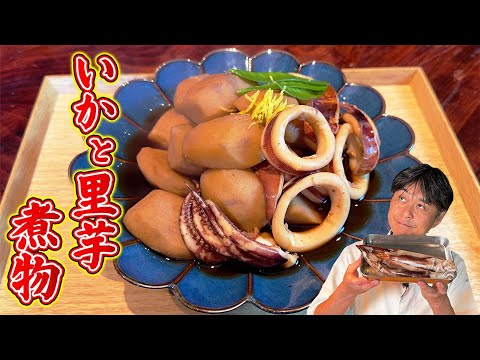
Ingredients
Main Ingredients (3-4 servings)
Seasonings
Steps
- Trim the top and bottom off 8-10 taro roots and peel them thickly. Do not rinse them with water at this stage. (Key Tip!) When peeling, avoid wetting your hands with water to prevent the knife from slipping due to the slimy texture.
- Cut the peeled taro into halves or quarters if large, or leave them whole if small.
- Briefly rinse the cut taro under water to remove slime.
- Lightly rinse 2 Japanese flying squid, then pull out the ink sac and tentacles from the body. Gently separate the body from the guts using your fingers, being careful not to break the ink sac.
- Remove the ink sac from the guts. (Key Tip!) The ink sac can stain, so remove it very carefully to avoid it bursting.
- Cut off the tough suction cup part from two of the longer tentacles.
- Remove the beak (tonbi) located in the center of the tentacles.
- Trim off the eyes of the tentacles very closely.
- Scrape off the hard shell from the suction cups of the tentacles with a knife.
- Cut the processed tentacles into manageable pieces, about two per piece.
- Pull out the cartilage from inside the squid body.
- Rinse the inside of the squid body thoroughly with water.
- Carefully pat the processed tentacles and body dry with paper towels. (Key Tip!) Thoroughly drying the squid helps to eliminate any fishy odor.
- Slice the squid body into 1cm thick rings.
- In a pot, combine 500cc water, 2 tbsp cooking sake, 2 tbsp mirin, 4 tbsp soy sauce, 2 tbsp sugar, and 3g kombu. Bring to a boil. (Key Tip!) Adding kombu when simmering seafood like squid creates a synergistic effect, enhancing the natural umami flavors.
- Once the liquid boils, add all the cut squid and simmer briefly for about 2 minutes. Remove the squid before it becomes tough. (Key Tip!) This short simmering time allows the squid flavor to infuse into the broth while preventing the squid itself from becoming rubbery.
- After removing the squid, add the taro to the simmering liquid. Once it boils, carefully skim off any scum that rises to the surface.
- Reduce the heat to low, cover with a lid (otoshibuta), and simmer the taro for about 10 minutes.
- Remove the tough strings from 8 snow peas.
- After 10 minutes of simmering, remove the kombu from the pot. Return the previously removed squid to the pot.
- Increase the heat slightly and gently stir to prevent the taro from breaking apart, simmering until the liquid reduces.
- Add the trimmed snow peas and simmer together.
- Turn off the heat when the desired amount of sauce remains.
- Serve in bowls and garnish with finely chopped yuzu zest. (Key Tip!) Flavors deepen further as stewed dishes cool. This dish can be stored in the refrigerator for 3-4 days after cooling.
🌾 Recommended Rice for This Dish
※HowToCook.JPが料理の特徴に合わせて選定しています。動画内でシェフが推薦したものではありません。
* Contains affiliate links
*This article contains Amazon affiliate links. We may earn a commission on qualifying purchases.
【賛否両論】笠原将弘の料理のほそ道さんの他のレシピ


Amazon 📦 Items for This Recipe (Editorial Picks) 3点
※Not endorsed by the chef. Selected by HowToCook.JP editorial team.
PR: Contains Amazon affiliate links



🍷 編集部おすすめペアリング
※HowToCook.JP編集部による提案です。動画内でシェフが推薦したものではありません。
シャトー・メルシャンの甲州を代表する銘柄きいろ香。繊細な和柑橘と上品なミネラル感。和食全般・刺身・天ぷらにぴったり
8–10℃ Amazonで探す →ニュージーランド マールボロの代名詞クラウディー・ベイ。青草・柑橘・ハーブの爽やかな香り。サラダ・山羊チーズ・シーフードに最適
8–11℃ Amazonで探す →吟醸香と米の旨みが調和した飲みやすい一本。焼き魚・煮魚・和風パスタなど和食全般に合わせやすい
10–15℃(冷酒・花冷え) Amazonで探す →米と米麹のみで醸したコク豊かな純米酒。燗にすることで旨みがさらに開花し、煮物・焼き鳥・濃い味の惣菜と絶妙にマッチ
15–55℃(常温〜熱燗) Amazonで探す →火入れをしない生酒ならではの溌剌とした風味とフレッシュな香り。刺身・カルパッチョ・夏野菜の浅漬けなど、素材の鮮度を活かした料理に最適
5–10℃(雪冷え〜花冷え) Amazonで探す →国産ホップを使ったフレッシュで繊細な香り。アルコール度数は低めで飲みやすい。和食・刺身・冷奴と驚くほどよく合う
6–10℃ Amazonで探す →日本でもっとも親しまれるピルスナースタイル。キリッとした炭酸と軽い苦みが特徴。揚げ物・焼き鳥・餃子など炭酸と合わせたい料理全般に
4–7℃ Amazonで探す →クリアな黄金色と上品な苦みが特徴のプレミアムピルスナー。食事を選ばない汎用性の高さが魅力。和食全般・刺身・寿司に
4–7℃ Amazonで探す →緑茶のカテキンが和食の旨みを引き立て、ほうじ茶は香ばしさで揚げ物・甘い料理のバランスを整える
冷・ホット(4–8℃ / 70–90℃) Amazonで探す →⚠️ お酒に関する注意事項
20歳未満の飲酒は法律で禁止されています。飲酒運転は法律で禁止されています。
妊娠中や授乳期の飲酒は、胎児・乳児の発育に影響するおそれがあります。お酒は適量を。