
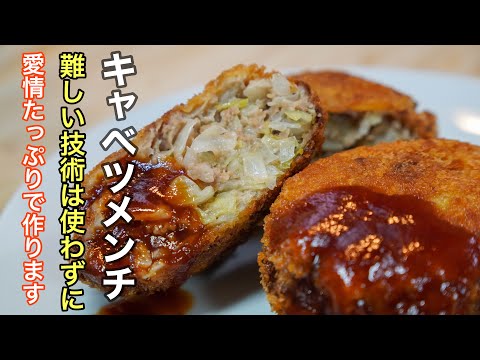
Ingredients
Main Ingredients (2 servings)
Seasonings
Steps
- Remove the core from 1/4 head of cabbage.
- Peel the cabbage leaves 2 to 3 at a time and cut them in half.
- Lay the cabbage flat and cut into 1cm strips, then turn and cut into 1cm strips again to create 1cm cubes. [Key Tip!] For parts closer to the core, it's best to first cut into 1cm strips, then chop roughly into 1cm strips to get 1cm cubes.
- Place the cut cabbage in a bowl, cover with plastic wrap, and microwave for about 5 minutes until thoroughly heated. [Key Tip!] Pre-heating the cabbage brings out its sweetness and prevents the meat from overcooking when frying the menchi katsu.
- Transfer the heated cabbage to a bowl, add 2 pinches of salt, and mix well. [Key Tip!] The salt is not for seasoning but to draw out excess moisture from the cabbage through osmosis.
- Fill a larger bowl with ice and place the bowl with cabbage on top. Let it cool for about 15 minutes, mixing every 5 minutes. [Key Tip!] Mixing with the ground meat without cooling will cause the meat's fat to melt, leading to a loss of flavor.
- Mix the sauce ingredients: 1.5 tbsp Worcestershire Sauce, 1.5 tbsp Ketchup, 0.5 tbsp Soy Sauce, 1 tbsp Sugar, 2 tsp Lemon Juice, and 1.5 tbsp Water. Combine them in a bowl and mix well.
- Make the batter: Whisk 1 egg in a bowl, then add 2 tbsp Water and 3 tbsp All-purpose Flour. Mix thoroughly with a whisk until smooth with no lumps. Chill in the refrigerator. [Key Tip!] Since the batter is a mixture of flour and egg, it can reduce the number of coating steps.
- Add the 180g of Ground Pork and Beef Mix, straight from the refrigerator, to a bowl. Add 2.7g of Salt and knead thoroughly until it becomes sticky. [Key Tip!] Use cold meat as warm meat will cause the flavorful fat to melt. Kneading with salt creates stickiness and seals in the juices.
- Add 1 Egg, 1 tbsp Potato Starch, and 10g Parmesan Cheese to the sticky meat mixture and mix until everything is combined.
- Squeeze out excess moisture from the cooled cabbage and add it to the meat mixture. Mix thoroughly. [Key Tip!] Thoroughly squeezing the cabbage prevents the menchi katsu from becoming watery and diluting the flavor.
- Divide the meat mixture into 4 portions. Shape each portion into a ball by tossing it back and forth like a game of catch to remove air. Check for any cracks. [Key Tip!] Removing air prevents the meat from cracking and the juices from leaking out during frying.
- Prepare for coating: Arrange a generous amount of Panko Breadcrumbs, the chilled batter (re-whisk if necessary), and the shaped menchi katsu.
- Gently dip the meat patty into the batter with your left hand, ensuring both sides are well coated.
- Transfer the battered patty to the panko. Use your right hand to scoop panko and cover the entire patty. Gently press to ensure the sides are also well coated. [Key Tip!] Using your left hand for the batter and your right hand for the panko helps keep your hands from becoming sticky and allows for smooth work.
- Fill a frying pan generously with oil and heat over medium heat to around 160℃ (320°F).
- Once the oil reaches 160℃ (320°F), reduce the heat to low and gently place the menchi katsu into the oil.
- Fry the menchi katsu for 2 minutes, flip, and fry for another 2 minutes. Repeat this process for a total of 4 sets (2 minutes per side, alternating). Adjust the oil temperature to maintain between 150℃ and 160℃ (300°F to 320°F) while frying. [Key Tip!] Frying for 4 minutes on one side can result in uneven cooking, so alternating sides is key.
- Remove any fried bits that appear during cooking, as they can cause burning.
- Remove the fried menchi katsu and let it rest for about 5 minutes. [Key Tip!] Resting allows the juices to settle, preventing them from flowing out when cut.
- While the menchi katsu is resting, gently heat the prepared sauce over low heat until it boils and thickens. [Key Tip!] Boiling the sauce mellows the acidity and allows the flavors to meld. The thickened sauce will adhere well to the menchi katsu.
- Cut the rested menchi katsu and arrange it on a plate.
🌾 Recommended Rice for This Dish
※HowToCook.JPが料理の特徴に合わせて選定しています。動画内でシェフが推薦したものではありません。
* Contains affiliate links
*This article contains Amazon affiliate links. We may earn a commission on qualifying purchases.



🍷 編集部おすすめペアリング
※HowToCook.JP編集部による提案です。動画内でシェフが推薦したものではありません。
シャトー・メルシャンの甲州を代表する銘柄きいろ香。繊細な和柑橘と上品なミネラル感。和食全般・刺身・天ぷらにぴったり
8–10℃ Amazonで探す →ニュージーランド マールボロの代名詞クラウディー・ベイ。青草・柑橘・ハーブの爽やかな香り。サラダ・山羊チーズ・シーフードに最適
8–11℃ Amazonで探す →吟醸香と米の旨みが調和した飲みやすい一本。焼き魚・煮魚・和風パスタなど和食全般に合わせやすい
10–15℃(冷酒・花冷え) Amazonで探す →米と米麹のみで醸したコク豊かな純米酒。燗にすることで旨みがさらに開花し、煮物・焼き鳥・濃い味の惣菜と絶妙にマッチ
15–55℃(常温〜熱燗) Amazonで探す →火入れをしない生酒ならではの溌剌とした風味とフレッシュな香り。刺身・カルパッチョ・夏野菜の浅漬けなど、素材の鮮度を活かした料理に最適
5–10℃(雪冷え〜花冷え) Amazonで探す →国産ホップを使ったフレッシュで繊細な香り。アルコール度数は低めで飲みやすい。和食・刺身・冷奴と驚くほどよく合う
6–10℃ Amazonで探す →日本でもっとも親しまれるピルスナースタイル。キリッとした炭酸と軽い苦みが特徴。揚げ物・焼き鳥・餃子など炭酸と合わせたい料理全般に
4–7℃ Amazonで探す →クリアな黄金色と上品な苦みが特徴のプレミアムピルスナー。食事を選ばない汎用性の高さが魅力。和食全般・刺身・寿司に
4–7℃ Amazonで探す →緑茶のカテキンが和食の旨みを引き立て、ほうじ茶は香ばしさで揚げ物・甘い料理のバランスを整える
冷・ホット(4–8℃ / 70–90℃) Amazonで探す →⚠️ お酒に関する注意事項
20歳未満の飲酒は法律で禁止されています。飲酒運転は法律で禁止されています。
妊娠中や授乳期の飲酒は、胎児・乳児の発育に影響するおそれがあります。お酒は適量を。